 2x
2x 99.7%
99.7%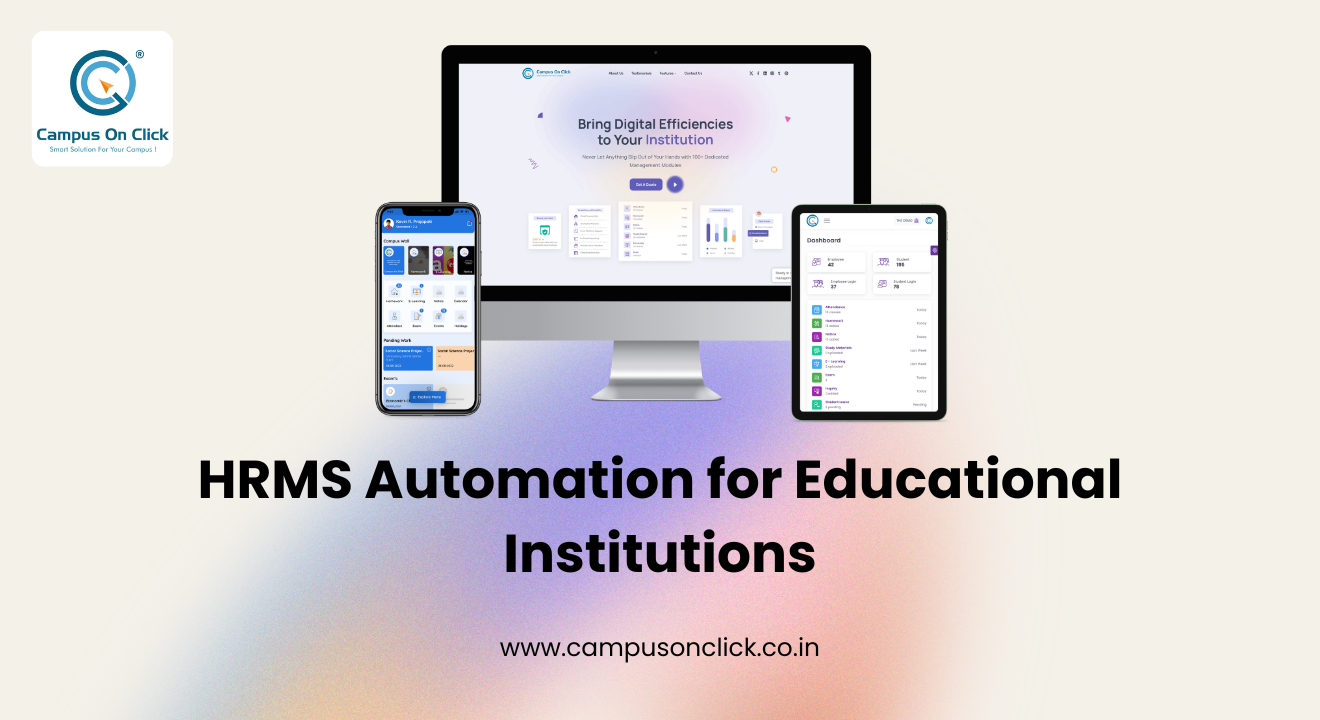
Managing people in an educational institution is no longer limited to marking staff attendance or processing monthly salaries. Schools, colleges, universities, coaching institutes, and training centers now manage teaching staff, non-teaching staff, visiting faculty, contractual employees, administrative teams, and multi-branch operations.
That is why HRMS automation for educational institutions has become an operational necessity.
An HRMS helps institutions automate staff records, attendance, leave, payroll, recruitment, onboarding, compliance, and performance workflows through one centralized digital platform. Instead of depending on spreadsheets, registers, paper files, and manual approvals, educational institutions can manage their workforce with better accuracy, visibility, and control.
For institutions in India, HR automation is especially useful because HR teams often need to manage payroll, PF, ESI, TDS, leave policies, staff documentation, and branch-wise reporting. Government-linked compliance ecosystems such as EPFO, ESIC, and income tax processes make accurate HR and payroll data important for employers. EPFO and ESIC operate under India’s Ministry of Labour and Employment, while salary TDS falls under India’s income tax framework
Quick Answer: Why Do Educational Institutions Need HRMS Automation?
Educational institutions need HRMS automation because it helps them manage staff attendance, payroll, leave, compliance, recruitment, onboarding, and employee records digitally. It reduces manual errors, saves administrative time, improves payroll accuracy, supports compliance, and gives management real-time visibility into faculty and staff operations.
In simple terms, HRMS automation for educational institutions helps schools, colleges, and universities run HR processes faster, more accurately, and more transparently.
What Is HRMS Automation in Education?
HRMS automation for educational institutions means using software to manage staff records, attendance, leave, payroll, recruitment, onboarding, compliance, and performance workflows digitally.
An education-focused HRMS is designed for institutions such as:
- Schools
- Colleges
- Universities
- Coaching institutes
- Training centers
- Multi-branch educational groups
- Edtech companies
Unlike generic HR tools, HRMS software for educational institutions should understand academic workforce structures. For example, a school may have teachers, substitute teachers, admin staff, transport staff, security staff, and support staff. A university may have professors, visiting faculty, researchers, lab assistants, department heads, and administrative officers.
A good HRMS brings all these employee categories into one organized system.
Why Educational Institutions Need HRMS Automation
Educational institutions deal with large volumes of employee data and recurring administrative tasks. When these processes are handled manually, errors and delays become common.
Here are the key reasons why institutions need HRMS automation.
1. To Reduce Manual HR Work
Many schools and colleges still manage HR through spreadsheets, registers, email approvals, and paper documents. This creates unnecessary workload for HR and admin teams.
Manual HR processes often lead to:
- Duplicate employee records
- Missing documents
- Delayed leave approvals
- Incorrect attendance entries
- Payroll calculation mistakes
- Difficulty finding past records
- Poor coordination between departments
With HR automation for schools, repetitive tasks can be digitized. HR teams can focus less on paperwork and more on staff experience, planning, and operational improvement.
2. To Improve Attendance Management
Attendance is one of the most important HR functions in educational institutions.
Teachers, professors, admin staff, lab assistants, transport staff, and support employees may follow different schedules. Some may work full-time, some part-time, and some as visiting faculty.
An attendance management software for schools helps institutions:
- Track daily staff attendance
- Manage biometric or app-based attendance
- Monitor late marks and early exits
- Handle shift-wise attendance
- Track branch-wise attendance
- Connect attendance data with payroll
- Reduce proxy or incorrect attendance entries
For multi-branch schools or colleges, automated attendance gives management a real-time view of staff availability across locations.
3. To Make Payroll More Accurate
Payroll in educational institutions can become complicated because different employee types may have different salary structures.
For example:
| Employee Type | Payroll Complexity |
|---|---|
| Full-time teachers | Fixed monthly salary, leave deductions, allowances |
| Visiting faculty | Hourly or session-based payments |
| Admin staff | Monthly salary, overtime, deductions |
| Contractual staff | Contract-based payments |
| Support staff | Attendance-linked salary calculation |
A payroll software for educational institutions helps automate:
- Salary calculation
- Attendance-linked deductions
- Leave adjustments
- Allowances
- Overtime
- Payslip generation
- Tax deductions
- Payroll reports
This reduces payroll disputes and improves trust between employees and management.
In India, payroll accuracy is also important because employers may need to manage statutory deductions such as PF, ESI, and TDS depending on applicability. EPFO administers provident fund-related social security, ESIC manages employee state insurance, and salary-related TDS is part of India’s tax deduction framework.
4. To Centralize Faculty and Staff Records
Educational institutions generate a lot of employee data, including:
- Personal information
- Qualification details
- Experience records
- Joining letters
- ID proofs
- Salary structure
- Department details
- Leave history
- Attendance records
- Performance reviews
- Training records
- Exit documents
Without a digital system, these records are often scattered across files, emails, and spreadsheets.
A faculty management software or HRMS centralizes all employee information in one secure system. This makes it easier for HR teams, principals, directors, and department heads to access accurate staff data when needed.
5. To Improve Compliance Readiness
Compliance is one of the most important reasons to adopt HRMS automation, especially for institutions operating in India.
Schools, colleges, and universities may need to maintain accurate records related to:
- Employee attendance
- Salary payments
- Leave records
- Employment contracts
- Statutory deductions
- Tax declarations
- Staff identity documents
- Experience and qualification records
Government bodies and compliance platforms in India increasingly depend on structured employer and employee data. For example, EPFO, ESIC, and tax-related systems require accurate employer-side records where applicable.
An HRMS helps institutions maintain organized digital records and generate reports when required.
6. To Speed Up Leave and Approval Workflows
Manual leave approvals can be slow and confusing.
A teacher may submit a leave request to a coordinator, who forwards it to the principal, who then informs HR. If this happens through paper forms or WhatsApp messages, records can easily get lost.
HRMS automation makes leave management structured.
Employees can:
- Apply for leave online
- View leave balance
- Track approval status
- Upload supporting documents
Managers can:
- Approve or reject requests
- View team availability
- Avoid staff shortages
- Maintain transparent records
This is especially useful during exams, admissions, parent-teacher meetings, inspections, and peak academic periods.
7. To Support Recruitment and Onboarding
Educational institutions often hire teachers, professors, counselors, coordinators, administrators, and support staff throughout the year.
Manual recruitment can lead to:
- Lost resumes
- Delayed interview scheduling
- Poor candidate tracking
- Incomplete joining documents
- Slow onboarding
With HRMS software for educational institutions, institutions can digitize recruitment and onboarding workflows.
An HRMS can help manage:
- Job openings
- Candidate applications
- Interview stages
- Offer letters
- Document collection
- Employee profile creation
- Joining checklists
This creates a smoother experience for both HR teams and new employees.
8. To Improve Transparency for Staff
Teachers and staff often need clarity about attendance, salary, leave balance, holidays, payslips, and HR policies.
Without an employee self-service system, they depend on HR teams for every small query.
A cloud HRMS for colleges or schools can provide employee self-service access where staff can:
- Download payslips
- Apply for leave
- View attendance
- Update personal details
- Access HR policies
- Submit documents
- Track requests
This reduces repetitive HR queries and improves staff satisfaction.
9. To Help Management Make Better Decisions
Educational leaders need accurate data to make workforce decisions.
For example, management may want to know:
- Which branch has the highest staff absenteeism?
- Which department has frequent leave conflicts?
- How much is the monthly payroll cost?
- How many vacancies are open?
- Which employees are nearing contract renewal?
- Which staff members need training?
A modern HRMS provides dashboards and reports that help principals, directors, trustees, and HR managers make informed decisions.
This is where employee management software for educational institutions becomes more than an admin tool. It becomes a decision-making system.
10. To Manage Multi-Branch Educational Groups
Many educational institutions operate across multiple campuses or branches.
For example, a school group may have branches in Delhi, Mumbai, Bengaluru, Pune, Hyderabad, Chennai, Ahmedabad, Jaipur, and Lucknow. Managing HR manually across these locations can become difficult.
An HRMS helps multi-branch institutions:
- Standardize HR policies
- Track staff across branches
- Compare payroll costs
- Monitor attendance by location
- Maintain centralized employee records
- Generate branch-wise reports
- Reduce dependency on local paperwork
For growing education groups, HRMS automation creates consistency and control.
Manual HR vs HRMS Automation in Schools and Colleges
| HR Function | Manual HR Management | HRMS Automation |
|---|---|---|
| Attendance | Registers, spreadsheets, manual entries | Digital attendance with real-time tracking |
| Payroll | Manual salary calculations | Automated payroll with deductions and payslips |
| Leave | Paper forms, emails, verbal approvals | Online leave requests and approval workflows |
| Employee Records | Physical files and scattered documents | Centralized digital employee database |
| Compliance | Manual report preparation | Organized records and downloadable reports |
| Recruitment | Resume folders and email tracking | Candidate tracking and onboarding workflows |
| Staff Queries | HR-dependent | Employee self-service portal |
| Reporting | Time-consuming spreadsheet reports | Real-time dashboards and analytics |
| Multi-Branch Management | Difficult to standardize | Centralized branch-wise visibility |
Key Features of HRMS Software for Educational Institutions
When choosing the best HRMS software for schools in India, institutions should look for features that match education-sector needs.
Essential HRMS Features
| Feature | Why It Matters |
|---|---|
| Employee database | Stores complete staff records in one place |
| Attendance management | Tracks staff presence, late marks, and shifts |
| Leave management | Automates leave requests and approvals |
| Payroll management | Calculates salaries, deductions, and payslips |
| Recruitment module | Helps manage hiring and candidate pipelines |
| Onboarding workflow | Makes joining formalities faster |
| Document management | Stores contracts, IDs, certificates, and HR files |
| Employee self-service | Reduces repetitive HR queries |
| Compliance reports | Helps maintain organized statutory and HR records |
| Role-based access | Protects sensitive employee and payroll data |
| Multi-branch support | Useful for school chains and education groups |
| Mobile access | Helps staff and administrators work on the go |
Practical Examples of HRMS Automation in Education
Example 1: School Attendance and Payroll
A private school has 150 employees, including teachers, admin staff, transport staff, and support staff. Earlier, attendance was collected manually and sent to the payroll team at month-end.
After using HRMS automation, attendance gets directly linked to payroll. Late marks, unpaid leaves, and approved leaves are calculated automatically. This reduces salary errors and saves HR time.
Example 2: College Faculty Management
A college has permanent professors, visiting faculty, lab assistants, and department coordinators. Managing faculty workload, attendance, and payments manually creates confusion.
With a faculty management software, the college can maintain department-wise employee data, track attendance, manage leave, and generate payroll reports in one system.
Example 3: Multi-Branch Coaching Institute
A coaching institute operates in five cities. Each branch follows different attendance and reporting methods.
With cloud HRMS, the head office can monitor staff attendance, payroll, vacancies, and employee records across all branches from one dashboard.
Local SEO Focus: HRMS Software for Schools in India
For Indian educational institutions, HRMS automation should be positioned around both operational efficiency and compliance readiness.
A location-focused blog can target searches such as:
- School HRMS software in India
- HRMS for schools in Delhi
- HRMS software for colleges in Mumbai
- Payroll software for schools in Bengaluru
- HR automation for coaching institutes in Hyderabad
- Cloud HRMS for colleges in Pune
- Best HRMS software for schools in Chennai
India has a large and diverse education ecosystem, and the Ministry of Education oversees school and higher education through separate departments. This makes institution-level workforce management an important operational area for schools, colleges, universities, and training bodies.
For stronger local SEO, create separate landing pages for major cities where your product or service is available.
How to Choose the Right HRMS for Educational Institutions
Before selecting an HRMS, decision-makers should evaluate the software carefully.
HRMS Selection Checklist
| Question | Why It Matters |
|---|---|
| Does it support schools, colleges, and universities? | Education HR is different from corporate HR |
| Can it manage teaching and non-teaching staff? | Institutions have multiple employee categories |
| Does it include attendance and payroll automation? | These are core HR needs |
| Does it support Indian payroll requirements? | Useful for PF, ESI, TDS, and salary reporting where applicable |
| Is it cloud-based? | Easier for multi-branch access |
| Does it offer employee self-service? | Reduces HR workload |
| Can it generate reports? | Helps management decision-making |
| Is it easy to use? | Important for HR, admin, and non-technical staff |
| Does it offer role-based access? | Protects confidential employee data |
| Can it scale with the institution? | Useful for growing education groups |
Where Campus On Click Fits In
Campus On Click helps schools, colleges, universities, coaching institutes, and training centers automate HR, payroll, attendance, staff records, and administrative workflows through a centralized digital platform.
Instead of managing HR through scattered spreadsheets and manual processes, institutions can use Campus On Click to bring workforce operations into one connected system.
For educational institutions looking to reduce admin workload, improve payroll accuracy, and gain better visibility into staff operations, Campus On Click can be positioned as a practical HRMS and campus management solution.
Conclusion
HRMS automation for educational institutions is no longer just a digital upgrade. It is a smarter way to manage people, payroll, attendance, compliance, and staff operations.
Schools, colleges, universities, coaching institutes, and training centers need reliable systems to manage growing administrative complexity. Manual HR processes may work for a small team, but they quickly become inefficient as staff strength, branches, compliance needs, and reporting requirements increase.
An education-focused HRMS helps institutions save time, reduce errors, improve transparency, and make better workforce decisions.
If your institution is still managing HR through spreadsheets, registers, and manual approvals, now is the right time to move toward automation.
Ready to simplify HR, payroll, attendance, and staff management? Explore how Campus On Click can help your educational institution automate HR operations with confidence.
FAQ Section
1. What is HRMS automation for educational institutions?
HRMS automation for educational institutions means using software to digitally manage staff records, attendance, leave, payroll, recruitment, onboarding, compliance, and performance workflows.
2. Why do schools need HRMS software?
Schools need HRMS software to reduce manual HR work, automate attendance, calculate payroll accurately, manage employee records, track leave, and improve staff transparency.
3. How does HRMS help colleges and universities?
HRMS helps colleges and universities manage faculty records, department-wise staff data, attendance, payroll, leave approvals, recruitment, and compliance reports in one centralized system.
4. What are the benefits of HRMS in the education sector?
The main benefits of HRMS in the education sector include reduced paperwork, accurate payroll, faster approvals, better compliance readiness, centralized employee records, and real-time management reports.
5. Is HRMS useful for coaching institutes?
Yes. Coaching institutes can use HRMS to manage teachers, counselors, admin staff, attendance, batch-wise schedules, payroll, and branch-wise employee data.
6. What is the difference between manual HR and HRMS automation?
Manual HR depends on paper files, registers, spreadsheets, and emails. HRMS automation uses software to manage HR workflows digitally, reducing errors and improving efficiency.
7. What features should an education HRMS include?
An education HRMS should include employee records, attendance, leave, payroll, recruitment, onboarding, document management, employee self-service, reports, compliance support, and multi-branch access.